What Are Good Pitching Mechanics?
This question is one of the most crucial and frequently asked by players and parents alike. Ask 10 different baseball experts, and you’ll probably get 10 different answers—if not more. However, standardizing an answer was the goal of a 2023 journal article published in The Journal of Sports Health titled, “The Clinician’s Guide to Baseball Pitching Biomechanics.”
I’m excited to highlight this study to help spread this valuable information.
Purpose of the Study
The article aims to explain proper baseball pitching mechanics based on 3D motion capture studies, describe common biomechanical flaws, and discuss corrective strategies. The authors are affiliated with the American Sports Medicine Institute (ASMI), pioneers in 3D analysis of pitchers. From 1989 to 2021, they collected data on 5,000 athletes, ranging from youth players to professionals, building an impressive repository of biomechanical insights.
A Word of Caution
There are many ways to throw a baseball hard, and I’ve even written a whole e-book about this topic. The mechanical information in this article serves as a starting point. There’s room for variation in how you throw, but every pitcher must adhere to the same physical laws and principles that allow for safe and effective throwing. Effective throwing, by the way, is just another way of saying “throwing gas.”
As long as your athlete is close to these standards, you should be in good shape. You can bend these rules, but you can’t break them.
The Key Take Aways
The article highlights two specific phases of the pitching delivery: the pitcher’s position at the moment of front foot contact and the sequence of movements between front foot contact and ball release.
1. Position at Front Foot Contact
At the moment the front foot makes contact with the ground, here are the critical positions and measurements to observe:
- Elbow Flexion: 90°
- Shoulder Abduction: 90°
- Horizontal Abduction: 20°
- Shoulder External Rotation: 45°
- Lead Foot: Slightly closed position
- Stride Length: 85% of the pitcher’s height
- Upper Torso: In line, facing first or third base
- Pelvis Rotation: Slightly open (about 30°) toward home plate

This is a lot of information to process. To simplify your evaluation, consider printing this list and using it as a checklist. I’ll follow up this article with a properly formatted checklist and instructions on how to use it.
2. Sequence of Events from Foot Contact to Ball Release
The next crucial aspect is what happens between front foot contact and ball release. The sequencing of these movements is where the real secret to success lies:
- Front Leg Knee Extension: From 45° to 30°
- Pelvis Rotation
- Upper Trunk Rotation
- Elbow Extension
- Shoulder Internal Rotation
To visualize this, here’s a slow-motion GIF of what that sequence looks like.
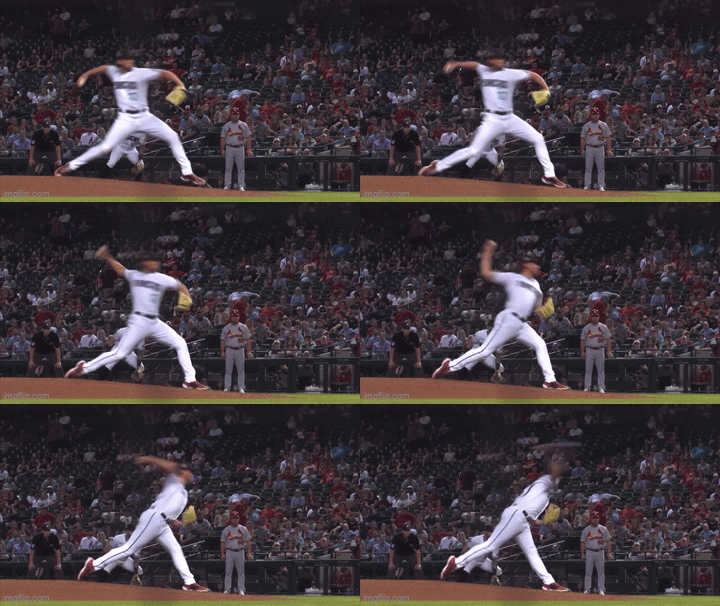
If you want to explore this with your own athletes, you’ll need a device capable of recording in slow motion. Fortunately, that’s pretty easy to obtain these days.
Even in slow motion, it can be challenging to determine the exact order of movements. We’re primarily looking for glaring errors and using this tool as an initial screen to identify the lowest-hanging fruit.
Thermostat vs. Thermometer
It’s fantastic if you can assess your athlete(s) as they throw. Understanding what might be holding an athlete back is valuable—just like knowing how hot or cold it is in your house. But what’s even better, far better, is using this information to make improvements, much like a thermostat would regulate the temperature.
In the next article, I’ll focus on how to do exactly that. We’ll start with the checklist I mentioned earlier and discuss what to look for and why it’s important. Then, we’ll dive into some of the advice that the study’s authors provided to the thousands of pitchers who came through their lab.
Until next time, thanks for reading
Graeme Lehman, MSc, CSCS, BBA

 Lehman's Baseball
Leave a comment