Let’s look at the freaks!! Or maybe we should call them outliers. This article will explore some of the shortest, tallest, lightest, and heaviest pitchers in the AL West.
My reasoning for writting and publishing this is simply to share what I am trying to learn. My goal in looking at the various types of bodies that stand on MLB mounds is gain more knowledge about the countless ways to throw at the highest level.
The previous post looked at the average pitcher, size-wise that is, on each of staffs in the American League West. Check it out here.
In this article I start to explore body mass index (BMI) measurment. The BMI was designed as a tool to provide some context as to how lean and healthy someone is solely based on their height and weight. It isn’t the greatest tool as we will see but is another measurement that we can use to start differentiating between pitchers to provide some more context.
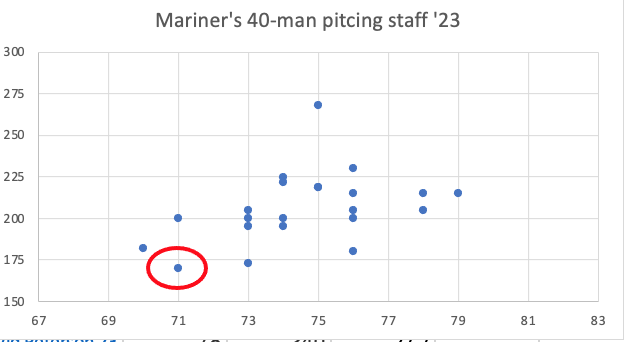
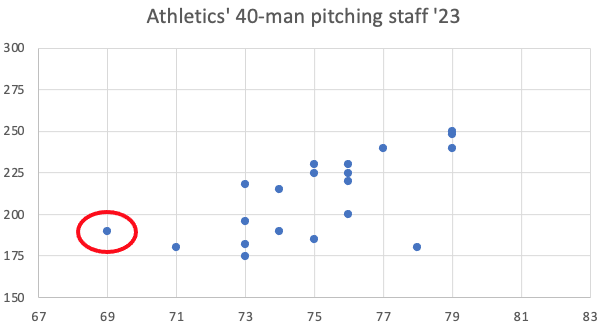
To show you what I mean let’s look at the biggest pitcher in the American League West, Carlos Estevez. Standing at 6’6″ he’s tied for being the tallest but what sets him apart is the fact that he weighs 277 lbs. That’s a big dude!!
I’ve circled him on his teams scatter plot

If you punch in those numbers, 78 inches and 277 lbs, into an online BMI calculator you will get a score of 32. Anything above 30 is considered obese for men. He doesn’t look obese to me.

This is why this scale isn’t very good at working on the level of the individual. It is a tool used to work with large populations.
So let’s get started looking at some of the pitcher who are either really tall, short, light, heavy along with the highest and lowest BMI’s.
Tall and Heavy
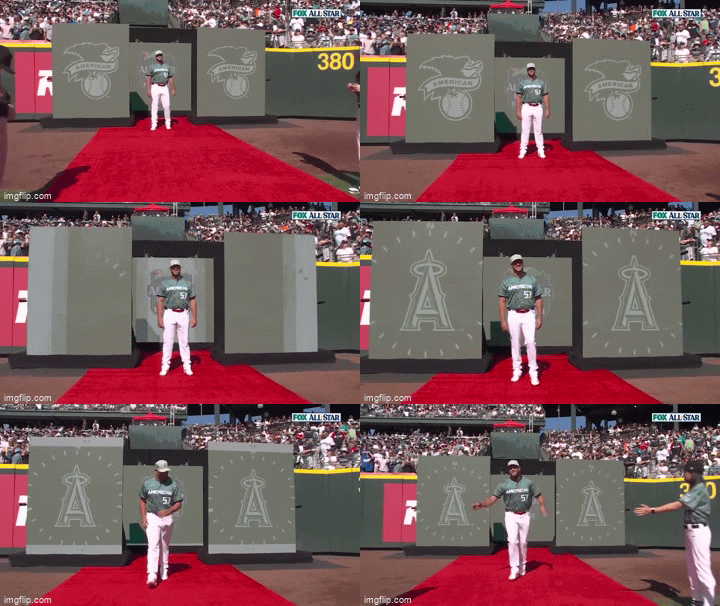
Let’s just keep going with Carlos Estevez. Here’s this giant in action. Look at him get off the mound to cover first base. This goliath of a human is pretty light on his feet. Sprinting can cause ground reaction forces around 5 times body weight. His legs are dealing with nearly 1400 pounds of force on each stride once he hits top sprinting speeds.
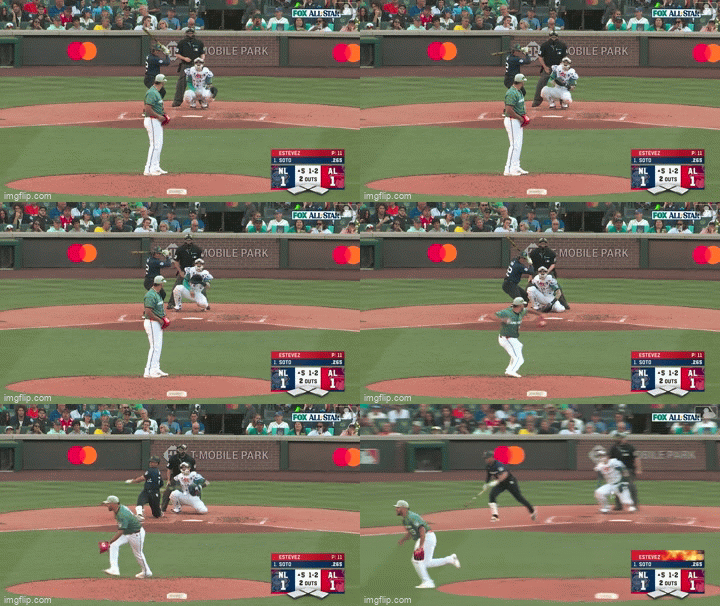
This is what he looks like at front foot strike before he got traded to the Angels.

Tall and Light
As a contrast here is what Logan Gilbert looks like in the same position. Logan is just as tall as Carlos at 6’6″ but is 62 pounds light at 215 lbs. Gilbert has a BMI of 24.8 and is one of the lightest 6’6″ guys in the league.
Light
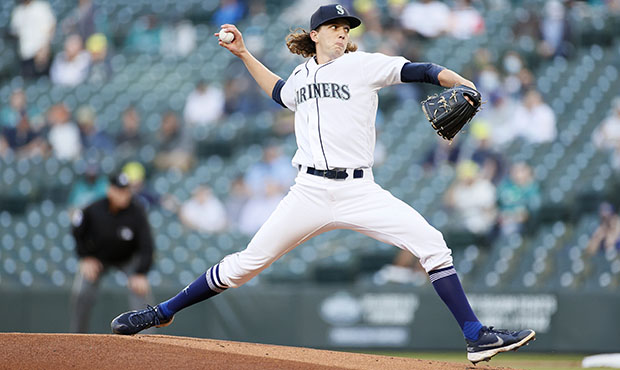
Matt Brash is 6’1″ but only 173 lbs. He uses this high strength-to-weight ratio to create some elite-level velocity.
Check out this nasty slider making one of the better hitters in the MLB, Joe Ramirez, look silly.

Let’s take a snapshot of this delivery from the side.

Here’s Carlos again with the Rockies who is 100 lbs heavier and half a foot taller.

If we only looked at guys who measured 6’1″ and went to the heavier end of the spectrum we’d find guys like the Astros Bryan Abreu. He’s a solid 225 lbs giving him a BMI of 29.7. Brash, by contrast, is 22.8 on the BMI scale.
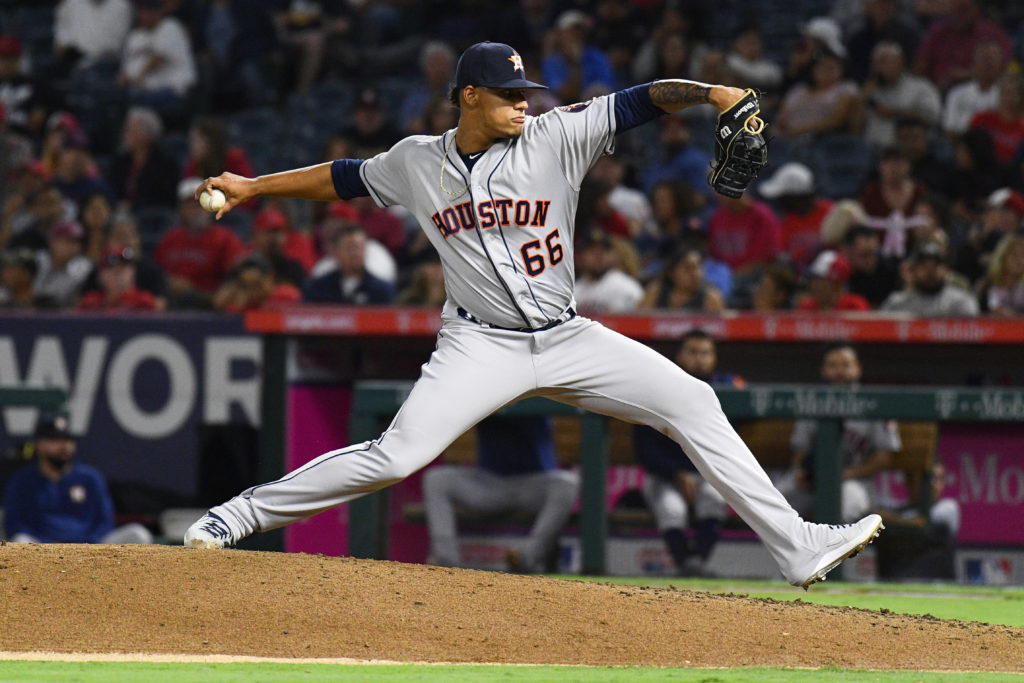
Short
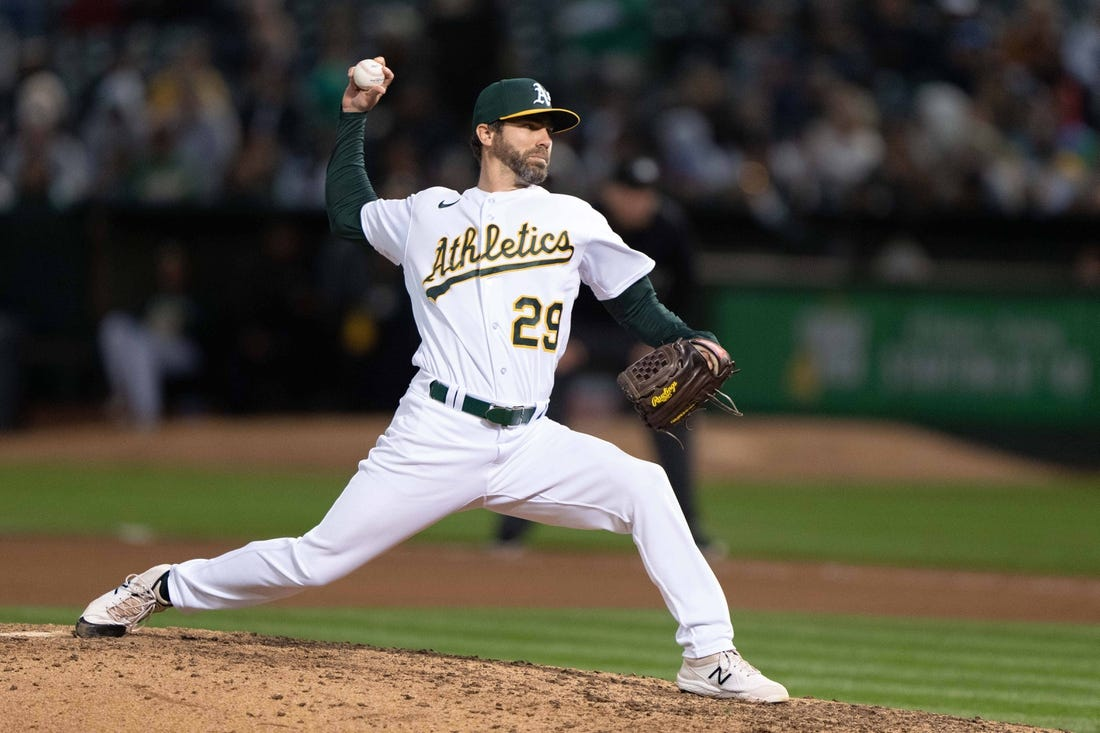
The shortest pitcher was a tie between a couple of guys. I am going to pick the heaviest and lightest in order to contrast. Austin Pruitt of the Oakland Athletics is 5’10” and 185 lbs which is good for a BMI of 26.5.
Here he is in action
Contrast this to Dominic Leone who is 30 lbs heavier while also standing 5’10”. Thirty also happens to be his BMI score. This is what he looks like at a similar point of the delivery while he was living in a foreign country.

Low BMI
When we look at this score alone we find these outliers. First off with the lowest BMI, we get Jimmy Herget who is the very definition of an outlier. His 21.2 BMI is a result of his being 6’3″ and 170 lbs.

High BMI
One of the highest BMIs goes to a recent member of the no-hit club, Framber Valdez. His 5’11” and 240 lbs frame gives him a 33.5 BMI. Here is what he looks like right before his front foot is about to hit the ground just like Herget in the picture above.

Thanks for reading. Next up, the National League East.
Sincerely,
Graeme Lehman, MSc, CSCS
 Lehman's Baseball
Leave a comment