The findings from a recent study really enforced the importance of a strong front leg assuming your goal is to throw a baseball really fast. We already knew that the front leg is important but this study digs a lot deeper into exactly HOW and WHEN you use this strength. It’s some great information and I am excited to share it with you.
The best part about this study is that the researchers suggest some really great ideas for the practical application of this information. I will share these with you and a couple of my thoughts and opinions at the end of the article.
Here is the study that I am talking about out of Ohio State University
Stride Leg Ground Reaction Forces Predict Throwing Velocity in Adult Recreational Baseball Pitchers.
- McNally MP1, Borstad JD, Oñate JA, Chaudhari AM. J Strength Cond Res. 2015 Oct;29(10):2708-15.
These researchers used a very expensive pitching mound with four embedded force plates used to capture the ground reaction forces in 3D created by both the back and the front legs throughout the entire pitching delivery.
Using subjects that either pitched in high school or college they concluded that there was a high correlation between pitches with higher velocity and the amount of force being applied to the ground with the front leg.
Again the information that the front leg is important to help transfer energy isn’t new but what is interesting is HOW and even more importantly WHEN this force is being applied to the ground.
How the Force is Being Applied
What I mean by how the force is being applied is in what direction its being put into and redirected by the ground. This picture of a runner shows you the different types of directions ground reaction forces can be applied.
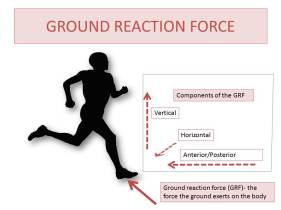
The vertical force is the easiest to understand. If you stand on a weight scale like the one pictured below and then pushed your feet into the scale as if you were about to jump you will see the scale go beyond your body weight. What you’re doing is applying vertical force and if your goal is to jump higher then you need to put more force into the ground.

When the front leg hits the ground during pitching there are vertical forces being applied to the ground and back up towards the ball. In fact, one of the main biomechanical differences between fast and slow throwers in a study by Matsuo et al. (2001) was the ability to have the front leg go into extension after landing. You need a lot of vertical force to go into extension rather than continue to go into more flexion. Here is an article about these biomechanical differences.
The most important direction however wasn’t the vertical but rather in the anterior/posterior direction. Here is a direct quote from the study.
“Force imparted by the stride leg against the direction of the throw appears to contribute strongly to achieve maximum throwing velocity”
The fact that the stride leg is applying force AGAINST the direction of the throw means that this force is being applied in a posterior direction. The back leg gets our momentum going towards the plate in an anterior direction but we must “slam on the brakes” and stop our momentum by applying force backward with the front leg. This catapults our body and ultimately the baseball toward home plate.

The coaching cue of “slamming on the brakes” was actually used in this study which I think is great because it provides coaches and athletes with a great visual analogy of what needs to happen. It sure beats yelling out “when you land, be sure to go into extension in a posterior direction!!!!”.
This “slamming of the brakes” by the front leg helps contributes to another of the biomechanical differences separating fast and slow throwers. The amount of forward trunk tilt angle at ball release was again separated fast (36.7 degrees) from slow (28.6 degrees) throwers. The only way to reach these kinds of angles is with, you guessed it, a strong front leg.


When you hear a pitching coach say “get out front and extend” this is what they are talking about. If you are more upright, meaning your vertical tilt angle is smaller, at ball release you don’t have the ability to throw harder for a couple of reasons:
- you are letting go of the ball further away from home plate which gives the hitter more time to see the ball – not a good thing
- you don’t give your muscles as much time to develop force and speed since you are letting go of the ball sooner – not good either
When do You Hit the Brakes?
The main conclusion from this study that the researchers really stressed was the exact point in time during the delivery when the front leg applied the most force in this posterior direction. Hit the brakes too early or too late and you have won’t reap the benefits of a strong front leg. It’s all about timing.
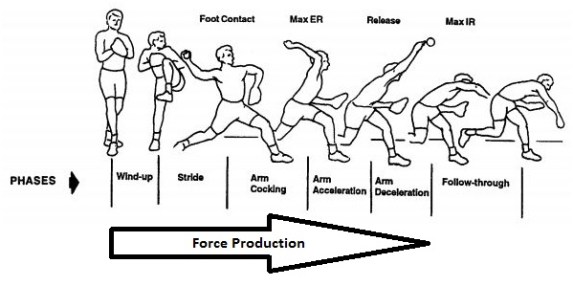
The point when you need the most force according to this research is when the throwing arm is in its cocking phase. The researcher’s used the term “window of opportunity” when describing the importance of peak amounts of force being applied into the ground in this direction due to the importance of timing and the sequential nature of pitching.
Here is Jeff Samardzija hitting the brakes. The next time you see him pitch watch him jump off his front leg which is a sign that some energy has been sent back up from the ground.
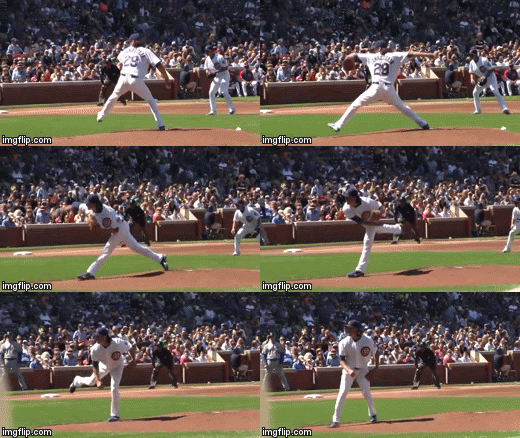
I’ve seen a lot of pitchers with the use of high-speed cameras extend their front leg but only after the ball was released. We want to have as much energy available to our throwing arm when it needs it, the arm cocking phase, in order to turn that energy into the momentum that we can use to launch this ball out of our hand.


This is really hard to pick up with the naked eye and if you’re a coach this is where some slow-motion video can come in handy as a tool to diagnose what is wrong with your pitcher’s mechanics.
**The front knee going into extension isn’t necessarily going to mean that the most force is being applied but unless you have a crazy fantastic pitching mound with an embedded force plate or two this is pretty much all we can do. The reason I say this is because you can apply a lot of force isometrically which means that your muscles are contracting but they aren’t moving thus making it impossible for us to see anything**
The Front Leg = Rate Limiting Factor
The fact that the highest forces were seen by the front leg doesn’t mean that the back leg isn’t important but it does tell us that the front leg is the limiting factor.
Think of it this way. If the front leg is the brake that means that the back leg is the gas and you don’t want to be driving a car that doesn’t have good enough breaks to handle the amount of power you can produce with the gas pedal. I know I wouldn’t.
Your back leg is responsible for initiating the forward momentum from a set position while the front leg has to catch the entire force created by your back leg and your body moving downhill. This makes it pretty obvious why we see higher ground reaction forces from the stride leg.
So if you can increase your ability to apply the brakes with the front leg then you can start hitting the gas pedal harder and at least increase your ability to throw harder. This combination of going faster and stopping quicker will really catapult the baseball out of your hand and past the hitter.
Practical Application
As I mentioned earlier the researchers did a great job of providing the readers with practical drills and exercises that are not hard to execute and in my opinion are spot on. I’ve added some of my own suggestions but here is how you can apply this information when you are:
Pitching
Think about this idea of slamming on the brakes. You have enough to worry about when you’re pitching (base runners, pitch count, etc) that if you think about much more than that you aren’t going to be able to use this information.
Bullpen
The authors suggested a throwing drill where you start on one knee (right knee for righties) and then try to stand up while making a throw to a partner.
Another idea might be to overload the slope of the mound making it more difficult for you to capture all that extra energy created with the steeper mound. You need to have a portable mound that you can safely jack up the back of the mound so it won’t move around on you. Or find a mound that they haven’t changed since 1968 when they lowered the mound by 5 inches due to guys like Bob Gibson posting a ridiculous 1.12 ERA.

The effect that I am going for here is to make your body realize the importance of the front leg by overloading it. You don’t need to crank it way up because more doesn’t always mean better. There might be some motor learning benefits to throwing off a slightly higher mound rather than throwing off a standard mound 100% of the time.
On-Field Athletic Drills
These can be done on the field or in the weight room but here is a basic progression of drills. The progression is important because we need to first learn how to land on the front leg before we can worry about landing and then jumping back again. Walk before you can run-type stuff.
With any of these drills stress the fact that we aren’t trying to stop on a rigid leg which would cause a real jarring effect which is something that would make throwing a strike challenging to do. Use the term “absorb” or “catch your momentum” to describe what we want.
Start with a very small box and the goal is to absorb that added energy. Make sure when viewing from the front that the knee doesn’t want to dive in.
The faster you run and the higher you hop the tougher it is going to be on that front leg to absorb that extra energy/momentum.
This one looks the easiest but it isn’t. Again absorb the landing then hop backward.
In the Weight Room
My favorite thing about this study other than the fact that my research was referenced was their suggestion to do Bulgarian Split Squats. Here is an entire article on this great exercise.
To take this exercise a step further you could add the variation of coming to a complete stop at the bottom of each rep. The stop isn’t designed to be a rest but rather to force your muscles to adapt and build strength from a complete stop.

I hope that you found this information to be useful and if you did please send it along to someone else who you think could benefit from reading this article.
Thanks,
Graeme Lehman, MSc, CSCS


 Lehman's Baseball
Leave a reply to Kevin Cancel reply