Today’s article is going to focus on running speed as it relates to the game of baseball. The kind of speed that raises your batting average with infield hits, the kind of speed that makes infielders rush plays. These are examples of real baseball speed.
When you think of the fastest athletes in the world you think of 100 meter sprinters how are undoubtably fast but do they have the kind of speed you want?
Running speed can be broken down into two basic categories (1) acceleration and (2) maximum running speed. The acceleration phase lasts roughly from the 0-30 meter mark and the maximum running phase kicks in after that until you reach your max running velocity which can’t really last much beyond 100 meters.
Which category do you think you should work on? Acceleration or Max Speed?
Well considering that the bases are only 27.4 meters (90ft) apart it becomes obvious that acceleration is more important than max speed. This should make you question the tradition of running a 60 yard dash as a means of scouting baseball players. Even if you rip a double, a triple on an inside the park home run you are running on a curve which doesn’t allow to reach top speed. If on defense you have run 60 meters in a straight line to field a ball you might want to question your defensive alignment. I wrote another article on the 60 yard dash that you can read here: New and Improved 60 yard dash
Types of Acceleration
Acceleration itself can divided into two phases (1) pure acceleration (0-15 meters) and (2) transitional acceleration (15-30 meters). Which one of these types of acceleration do you think is more important in baseball? Well if you caught the advanced on-line publication of Dr. Eugene Coleman’s and Dr William Amonette’s study you would know just by looking at the title.
Pure Acceleration is the Primary determinant of Speed to First-Base in Major League Baseball Game Situations
From 2007 to 2010 a coach in the Houston Astro’s bench sat in line with first base and timed how long it took 302 different players to reach first base. Those 302 players by the way represented approximately 67% of every position player in the majors during that time span. In total they timed 1896 sprint times from home to first unless the ball was hit by a pitcher, designated hitter or a lollygagger. If you don’t know what a lollygagger is watch this clip from the best baseball movie of all time Bull Durham.
In addition to timing them to first base, which is a pretty standard practice among baseball coaches, they also took a split time at the half way point between home and first. Home to first is 90 feet (27.4m) and the running lane starts exactly at the 45ft (12.7 m). They used the first half time split (0-45ft/12.7m) as their pure acceleration time and the second half (45ft/12.7m-90ft/27.4m) as their transitional acceleration time split.
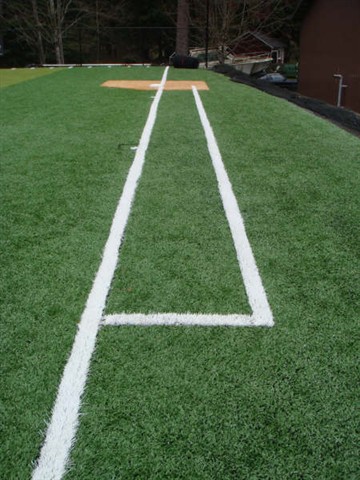
Through the use of some fancy statics these authors were able to determine that the first half was more important than the second half in determining your total home to first time.
This is Great News
If you are an aspiring young baseball player trying to climb your way up the baseball ranks this is great news because now you know what you need to work on in order to make a real difference in your game. You need to work on your pure acceleration.
Here are times from the study broken down into positions in case you want to compare yourself.
| Cathers (n=35) | Fastest Time | 75th percentile | 50th percent | 25th percent |
| Home to running lane | 2.51 | 2.65 | 2.77 | 2.86 |
| Home to first base | 4.24 | 4.41 | 4.53 | 4.64 |
| Infielders (n=138) | ||||
| Home to running lane | 1.97 | 2.53 | 2.61 | 2.7 |
| Home to first base | 3.84 | 4.24 | 4.36 | 4.46 |
| Outfielders (n=129) | ||||
| Home to running lane | 2.25 | 2.49 | 2.57 | 2.68 |
| Home to first base | 3.81 | 4.18 | 4.31 | 4.42 |
| reference #1 |
Pure Acceleration
The running technique that you need to get your body going from stand still is very different than the one you usually hear about when people are taking sprinting techniques which are geared towards max speed. First of all you must lean forward a lot more than normal. Try looking at the ground until you pass the start of the running lane. 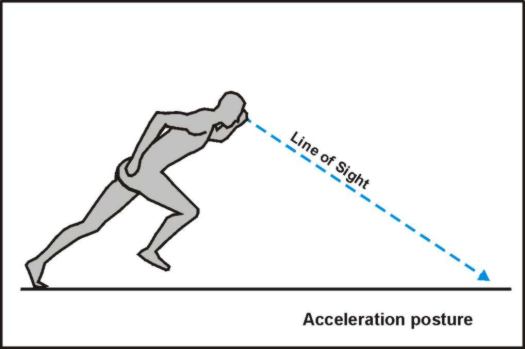 The first couple of steps are also going to be a lot slower in the sense that your feet will be in contact with the ground longer compared to top end speed. Since your feet will be touching the ground for more time it is important to put as much force into the ground as you can. Putting force into the ground is the name of the game. The more force you put into the ground the more you stand to benefit from when it comes back up and pushes you forward.
With our forward lean we really need to focus on pushing this force not only into the ground but behind us as well. Try thinking about pushing the ground away from you. This is pure physics: every action as an opposite and equal reaction. 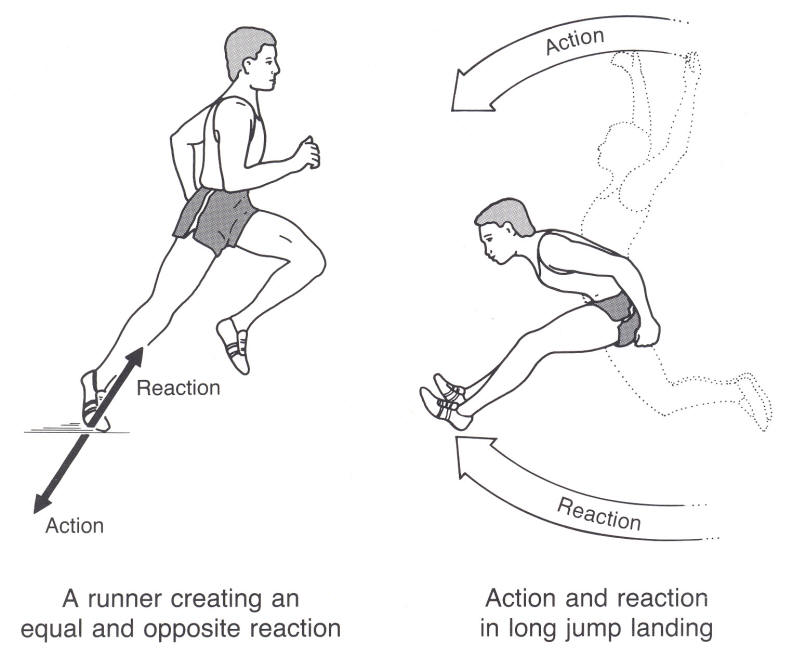 Newton’s Third Law in Action
The best way to increase the amount of force you put into the ground is with weight training. Use big compound exercises like Squats, Deadlifts, Bulgarian Split Squats, RDL’s and Hip Thrusts with high loads (75-90% of your max) for 2-6 reps and multiple sets. If these lifts are your primary focus in the weight room and you continue to improve upon them you will increasing your running speed or at least your potential to run faster.
Forget the 60 yard dash and Worry About your 10 yard dash
The 10 yard dash is becoming a more and more popular test for sports like baseball, football and any other sport that relies on bursts of acceleration. The test itself is pretty simple: mark off 10 yards and get someone who is good and quick with a stop watch to time you. Practicing this test will help you get better at accelerating plus it’s not too hard on the body since it hopefully won’t last more than 2 seconds.
How do you rank?
Below is a chart with some ten yard dash times from some published studies that looked at professional baseball players along with some times from college players from my own study that recently got accepted and will be published soon.
| Pro Players (Texas Rangers) | |
| Level | 10 yard dash |
| Rookie Ball | 1.57sec |
| A Ball | 1.59sec |
| AA Ball | 1.58sec |
| AAA Ball | 1.55sec |
| MLB | 1.52sec |
| Reference #2 | |
| Pro Players (Mets, Reds, Tigers & Rangers) | |
| Age | 10 yard dash |
| under 16 | 1.65sec |
| 20-22 | 1.64sec |
| 23-25 | 1.63sec |
| 26-28 | 1.62sec |
| Reference #3 | |
| NWACC & NAIA College Baseball Players | |
| Throws | 10 yard dash |
| Righties | 1.62sec |
| Lefties | 1.66sec |
*These numbers are from my study
I hope that this shed some light on why acceleration is more important than max speed along with a couple of ideas and guideline to help you improve you ability to accelerate.
Graeme Lehman, MSc, CSCS
References
1. Eugene Coleman A, Amonette WE. Pure acceleration is the primary determinant of speed to first-base in major-league baseball game situations. J Strength Cond Res. 2012 Jun;26(6):1455-60.
2. Hoffman JR, Vazquez J, Pichardo N, Tenenbaum G. Anthropometric and performance comparisons in professional baseball players. J Strength Cond Res. 2009 Nov;23(8):2173-8.


 Lehman's Baseball
Leave a comment