Here we go with a geeky blog post about throwing mechanics. As you may or may not know I am in the midst of doing some research for my master’s degree where I am looking at the correlation of various lower body power tests and throwing velocity. As a result I am reading a lot about what the legs do during the act of throwing a baseball. Today I am taking a more in-depth look at the stride leg.
If you like this post you might like my post of the ground reaction forces of pitching where I discuss the trail leg in more detail.
https://lehmansbaseball.wordpress.com/2010/12/20/ground-reaction-forces-of-pitching/
Here we go.
Proper lead leg positioning at foot plant allows for optimal rotation of the hips, pelvis and trunk (Dillman, Fliesig, Andrews – 1993) which is crucial to provide the most effective transfer of energy through the kinetic chain.
The strength of the front leg is an important factor in creating optimal throwing velocity. Matsuo et al. (2001) demonstrated this when they measured 12 kinematic and 9 temporal parameters between high velocity and low velocity pitchers and found that the amount of flexion and extension of the front knee was significantly different between the two groups.
Matsuo et al (2001) identified four common knee movement patterns with their subjects. Eighty three percent of the high velocity versus 35% of the low velocity throwing group was classified as displaying either the “A” or “B” patterns which displayed more knee extension than the “C” or “D” patterns. Sixty nine percent of the high velocity group was categorized in the “A” pattern which showed small amounts of both knee flexion and extension (50-60 degrees) during the initial 60% of the time interval between front foot contact (0%) and instant of ball release (100%). From the 60% to the 100% interval time mark the knee extended from approximately 55 to 30 degrees. Only 9% of the low velocity group was classified as having the “A” pattern. At the other end of the spectrum is the “D” pattern where the front knee continued to flex from approximately 20 to 50 degrees throughout the entire pitching motion 0-100% time interval. Seventeen percent of the low velocity group demonstrated the “D” pattern while none of the high velocity group fell into this category.


This supports the data presented by Escamilla et al (1998) which reported that collegiate pitchers demonstrated knee extension just prior to maximum external rotation of the glenohurmeral joint during a fastball pitch. The front knee continued to extend throughout the throwing motion as the trunk moves forward and rotates towards the intended target during which time the arm accelerates. This ability to brace the front knee allowing for optimal forward trunk tilt and rotation was identified as a characteristic of high velocity pitchers by Elliott et al. (1998).
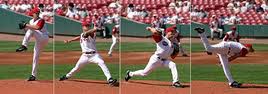
Similar knee movement patterns are also seen in elite level javelin throwers who display the ability to produce a clear double flexion extension pattern which is seen in the “A” pattern in the Matsuo et al.(2001) study. During the javelin throw the role of the front knee is to brace the body in order to aid in the transfer of energy from the ground up the kinetic chain to the trunk and upper extremity which are accelerating forward. (Whiting et al 1991)

High velocity cricket bowlers have also been shown to exhibit similar front knee movement patterns. Wormgoor et al. (2010) demonstrated that greater front knee extension at ball release was the biomechanical factor that correlated the highest with throwing velocity.

Ground Reaction Forces
After front foot contact the lead foot applies a braking force in order to slow down the forward momentum and begin to transfer the kinetic energy back and up the kinetic chain. When the arm is in maximal external rotation the front leg applies approximately 1.5 times body weight while also applying braking forces of nearly 0.75 times body weight. (MacWilliams et al. 1998)
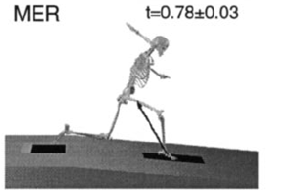
This study also reported that high wrist velocity was highly correlated with both landing anterior shear force “braking”(r2=0.70) and landing resultant force (r2=0.88) at the point of ball release. Basically the more force exerted by the front leg translated into higher throwing velocities.
Muscle Activation
Campbell et al. (2010) reported high levels of EMG activity in the stride leg that exceed 100% of MVIC with the high values seen during the arm cocking (phase 3) and acceleration (phase 4). During the arm cocking phase the Gastrocnemius, Vastus Medialis, Rectus Femoris, Gluteus Maximus and Bicep Femoris produced mean values of 140, 166, 167, 108 and 99% of MVIC respectively.

During the arm acceleration phase the Gastroc, VM, RF, GM and BF produced mean values of 126, 89, 47, 170 and 125 of MVIC respectively. The stride leg functions to dynamically stabilize the hip and knee joints in a single leg stance to maintain standing posture for the trunk and upper extremity to pivot about in order to produce an efficient follow through.
Like I said this was going to be a geeky read but if you made it this far I thank you for your time. I am putting a big push on this thesis of mine so if you liked this kind of blog post there will be more to follow.
Graeme Lehman


 Lehman's Baseball
Leave a reply to adrian Cancel reply