In the last article about Over-Speed training, I alluded to something I call a “Throwfile” and how it could be used to help gain more insight into athlete’s physical needs.
My “Throwfile”, as it stands today, is made up of two assessments using long toss and weighted balls. Today I’m just going to focus on the long toss portion. From here I am going to loosely adapt a concept from the sports science world that compares various types of vertical jumps to gain some clues that can be used to help tailor training to the needs of each athlete.
The sports science concept I’m referring to is called the reactive strength index (RSI). This simple test tells how well we use elastic energy. Throwing a baseball requires a ton of this type of energy to be successful, both upper and lower body elastic energy.
The traditional RSI has the athlete perform two jumps. The first is a countermovement while the second test has the athlete drops from a step (6-18″) then immediately jump as high as possible. The drop from the step will cause more of a stretch reflex so, in theory, this jump should be higher than the countermovement jump. And in most cases that’s true but the percentage difference between the two has been used to help guide and tailor the training programs for individual athletes.
The athlete that can jump a lot higher after falling off a step has a high RSI and is good at storing and releasing energy. Whereas the athlete who jumps are fairly similar in height isn’t as good with elastic energy. This athlete relies a lot on just their muscles to get off the ground.
This test has its limits for baseball since it doesn’t give us any information about the upper body. That being said, I still like the traditional test as I just described to help determine strategies of how an athlete should load their drive leg into the mound during the initial stage of the delivery. If an athlete has a high RSI then I think they would be better suited to implement a more elastic dominant approach to loading their back leg with what I call a “Press n’ Pop” style. Whereas an athlete with a low RSI would need more time to develop power with a muscle dominate approach to developing momentum towards home plate. I call this style “Dig and Drive”. Check out this article to learn about these styles and how I’ve tried to re-name the old “Tall & Fall” and “Drop n’ Drive” with these newer and more scientifically driven names.
If we can measure the speed and/or distance of two different types of long toss throws we can create our own “Long Toss RSI”. The first throw would be a long toss but from a stationary position. Spread your feet, lean back, and throw. This is what I would consider to be the equivalent of a countermovement jump. The drop jump that creates more of a stretch would be a traditional long toss with a crow hop.
Here’s some data I presented in my last article about 3 pitchers who all threw 86mph from the mound. What we see here are their long toss scores with a traditional long toss with a crow hop and with a stationary long toss.

The last column on the right is what I’m calling their long toss RSI which simply shows the percentage of one’s stationary long toss to their crow hop.
If you’re more of a visual kind of learner here’s what the slopes of each individual look like when you plot the data.

The slope that’s the most vertical belongs to athlete “C” in green due to the big drop off between types of long toss throws. This suggests, to me, that he relies on elastic energy the most. In contrast to athlete “A”, the flattest slope, who doesn’t do as good of a job of storing and releasing elastic energy from the added momentum with a crow hop.
An easy way to remember the differences between the types of slopes is to think of a pitchers mound. The athlete with a fairly flat slope would do well on a mound that is also flat. Whereas the athlete with a more vertically orientated slope needs that steeper angle in order to help develop more momentum prior to loading and unloading the elastic energy in his arm.
In my opinion, this is a pretty simple assessment that can give us some insight plus, in my experience, athletes like doing this kind of testing. It has its limitations since there are only two data points. If we can add in some more varieties of long toss with varying degrees of pre-throw momentum we can find out more about their elastic properties.
Here’s a list of 5 different variations of long toss each with more pre-throw momentum.
- Stationary: feet spread apart, shift your weight back and throw
- Step Behind: take one step and throw
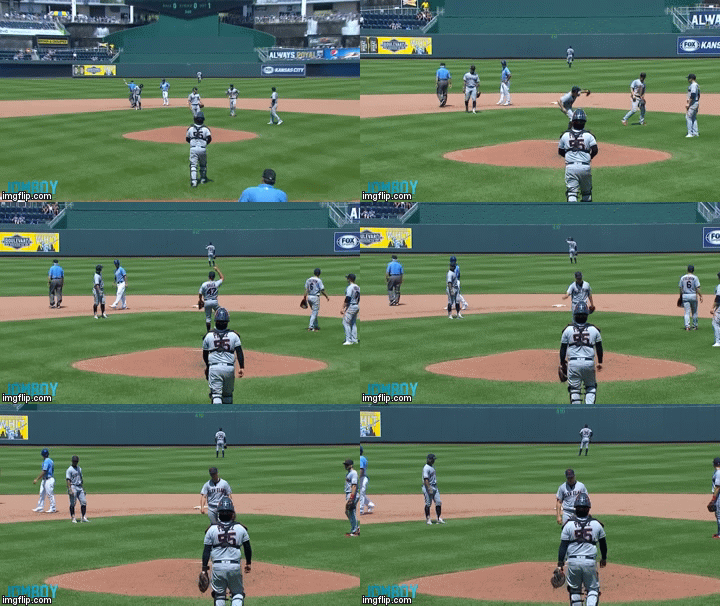
- Trevor Bauer In-Game Long Toss
- Shuffle: gain some momentum like a shortstop making a solid throw with a slow runner
- Crow Hop: limit the approach to a max of 5 steps before throwing
- Javelin: get a run at it and let it fly!!!
Here’s what #3 looks like:
I got the idea of using a variety of throws when I was reading about Incremental Drop Jumps, a variation of the reactive strength index.
To execute incremental drop jumps, get the athlete to drop off of increasingly higher and higher boxes to find the point where they can’t increase their vertical jump. Eventually, you get to a point where the muscles cannot handle the amount of force eccentrically from the drop to allow for the quick transition back up as try to jump. If you and your muscles can’t handle these forces in a timely manner you lose the potential of the elastic energy stored in the tendons.

Here’s an example of what an incremental drop jump test assessment might look like with vertical jump scores on the vertical axis and the height of the box along the bottom. Here we can see an obvious drop off when the athlete used the 30-inch box. Sports scientists have used this information to find the optimal height that each athlete should be using during the training process.
For our purposes in baseball, instead of jumping off of higher and higher boxes, we would use the long toss variations. By adding more and more momentum prior to throwing as we go down my list of long toss variations we increase the amount of energy being stored in our tendons. If we have the strength to handle these higher forces during the loading phase we should be able to produce more force during the unloading phase which would obviously result in longer throws.
If the throws don’t get longer as you go down the list you’ve got yourself a clue!!!
In this case, it would mean that the athlete cannot handle the added stretch to the shoulder internal rotators that caused by the added momentum.
My solution to this problem would be to perform a higher percentage of long toss throws with the type of throw where the distance decrease occurs. By doing so we would be effectively training the athlete in an over-load fashion in regards to their stretch-shortening ability. This coupled with a good overall strength & conditioning program should help this athlete improve their ability to handle increased forces.
If an athlete can incrementally add distance between each type of throw, which is most often the case, then we need to look at the slope again which is beefed up with more data points. I wish I could give you some actual numbers to look for in regards to the slope in order to classify pitchers but I just don’t have enough data to set these types of parameters. Sorry.
Now its time for a couple of disclaimers so that if you try and do this type of testing on your own please take into account everyone’s throwing mechanics and launch angle.
*mechanical disclaimer – watch the athlete as they perform these throws to ensure that their mechanics are somewhat similar. If they can’t throw further due to some type of mechanical change then this information isn’t relevant. They need to practice each of these throws in order to make this data relevant. The good news is that most baseball players long toss on a regular basis so they can practice these different types of throws and minimize any mechanical discrepancies.
*trajectory disclaimer – if you have an athlete that can’t optimize their “Launch Angle” when they perform all of these types of throws then you can’t use this information. This would be your clue that this pitcher really needs to work on other aspects of their game since finding an optimal trajectory is way easier than painting the outside corner of the plate.

 Lehman's Baseball
Leave a comment