The athletic attribute of “over-speed” wasn’t even on the original profile that I first created over 3 years ago but I think it’s important enough to add it in. So here we go!! Check out the new and improved graphics.

It’s not that important where I put it on my profile but it is important that we know where “Over-speed” sits on the force-velocity curve. Over-speed isn’t represented on many force-velocity curves but if it was it would be at the extreme bottom right-hand side of the graph.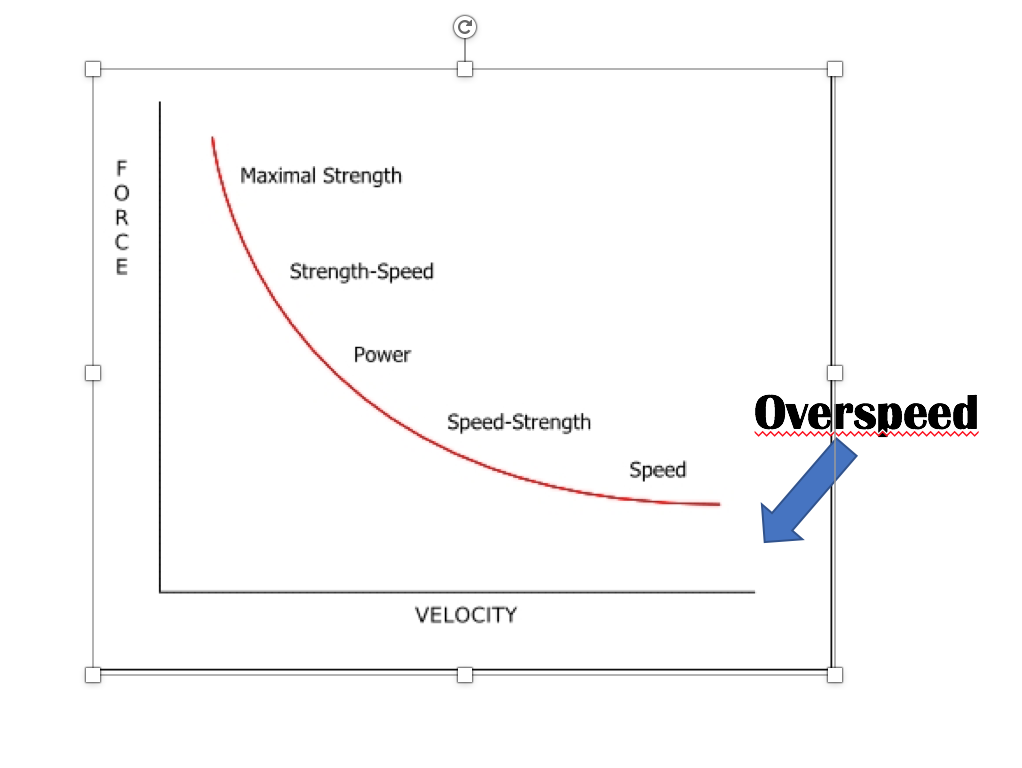
Coaches in other sports might put any type of over-speed training into the “speed” category. But in baseball I think it deserves its own category because we use it a lot with training tactics and tools like:
- Long Toss
- Run n’ Gun Throws
- Underweight Throws
Over-speed training in other sports might consist of an athlete running downhill or, if you see an athlete using bands to jump higher and faster like you see below you’ve witnessed some over-speed training.

In golf, you might see some athletes doing their best impression of Happy Gilmore.

Basically, anything that allows you to go faster than you would during the actual sport is over-speed. And while throwing a baseball is very fast there ways to go faster. Namely by reducing the weight of the ball and/or adding momentum prior to throwing.
Now we can focus on trying to figure out how much over-speed we need. Obviously, we want to really high levels of this type of athleticism due to its specificity to pitching. This is the reason that throwing programs that included some or all these types of over-speed training have been so successful. Programs built by Jager or Driveline come to mind.
Assessing an athlete’s over-speed abilities is simply a matter of measuring the speed and/or distance of some various throwing drills. Once we’ve done that we can start to put together the athlete’s “throwfile”.
The “throwfile” is a mini-profile that sits inside this bigger and more comprehensive athletic profile that I’ve been building. It focuses only on various types of throws and its high-level of specificity is the reason it gets its very own profile within a profile.
The word “throwfile” is not trademarked yet so feel free to use it all you want. I will really dig into this concept in my next article but in the meantime here’s a simple example of what I am talking about.
Below you will see some numbers from 3 different pitchers from the College of Central Florida Patriots a couple of years ago when I worked with them remotely. I picked these 3 athletes because they all threw 86 mph from the mound at the time of the testing.

Here we see their results from their long toss testing where we had them throw with a crow hop and the constraint of a stationary throw. The goal with both was to throw the ball as far as possible.
The right-hand side of the table has their testing results with Run n’ Gun throws using a 4, 5 and 6-ounce baseball. If you don’t know what a Run n’ Gun Throw is here is an example of a long time client of mine Isaac Greer hitting 109mph at Driveline with a 3oz ball. Based on this assessment I told him he needed a hair cut.
Looking at athlete “A” right off the bat, I think that he needs to spend more time and effort getting faster. He has the lowest long toss scores and he can barely throw harder than his mound velocity when he adds momentum and throws a lighter ball.
While athlete “C” looks like he needs to get stronger because of the fact that he has the biggest drop off’s when the momentum is restricted and when the weight of the ball goes up. Typically if you slow down when the weight goes up it means that you aren’t strong enough. We saw this with the weighted jump research that I highlighted in this article.

*Mechanical Disclaimer: this information is only good if the pitcher has somewhat proficient mechanics both on the mound and while performing long toss. If not the numbers are useless.*
By using this kind of simple data we can really make good use of this information by helping the individual get better. We’ve all seen the guy who can long toss the s*#t out of the ball during the pre-game but then can’t come close to reaching the same high level of velocity from the mound. I call these guys “over-speed all-stars”.
My theory with “over-speed all-stars” is that the added momentum allows the athlete to take full advantage of their elasticity which they can’t fully exploit while on the mound. This is similar to how if you perform a drop jump you should be able to jump higher since there’s added momentum during the loading phase to cause more of a stretch. This augmented stretch during the eccentric loading causes an enhanced stretch-shortening cycle which plays a vital role in sporting actions that take place in short periods of time such as throwing and jumping. In fact, 50% of the energy produced during a throw is thought to be contributed to the elastic properties in and around the shoulder (http://scholar.harvard.edu/files/ntroach/files/roach_et_al_2013.pdf).
The reason these guys can’t reproduce this effect when on the mound is that they don’t have enough strength and power. Without the crow hop, they don’t have the ability to produce enough of a stretch to elicit a big-time stretch-shortening cycle allowing them to take advantage of their over-speed abilities.
Analogy time: It’s like if you had a Drag Racer that was really fast when it reaches the fifth gear but it took you almost the whole quarter mile long track to get through gears 1 to 4.
So, for example, if your long toss with a crow hop is way further than your long toss from a stationary position, you have a good 5th gear but your gears 1 through 4 need some work. What I am trying to say here from a sports science point of view is that long toss with a crow hop is essentially a drop jump while a stationary long toss throw could be considered a countermovement jump.
If we can make these assumptions then we can steal a concept from the sports science world knows as the reactive strength index (RSI) which I’ve covered in the past. Basically, you look at the difference between a drop jump and a countermovement jump to help determine how an athlete produces force and what adjustments should be made to their training program as a result of this information.
This is something that I will explore in my next article.
Graeme Lehman, MSc, CSCS
 Lehman's Baseball
Leave a comment