First of all I need to apologize for that cheesy title but I really wanted to write this article even if I couldn’t come up with anything better.
My goal in this article is to convince you that we should do away with the terms “tall n’ fall” and “drop n’ drive” and replace them with words that do a better job of describing the athletic nature of throwing a baseball. If you’re reading this site you probably don’t use these terms anyways but you will undoubtably come across some coaches that do because that’s what they were told. So please show them this article which will hopefully at least start the conversation of how to improve things, even if you don’t agree with the changes that I suggest.
This is something that I’ve been thinking about for a while now but I finally got the motivation to put my thoughts down on paper because of this little guy in the picture below. This is my son who is about 8 weeks old in this picture when I first measured his shoulder mobility. Joking of course.

Only time will tell if he’s going to get into baseball but if he does I don’t want him to be subjected to this outdated and plain old bad coaching terms that I was. Since baseball isn’t the fastest at doing away with the old and in with the new, I wanted to get the ball rolling on this terminology change now.
I have a particular hate for these terms because as tall kid I was told many times to be “tall” and then “fall” towards home plate in order to take advantage of my height and leverage. This robbed me of what little athletic ability I had and in essence neutralized any leverage I possessed. When I look back at pictures of me as a kid before I was “coached” my delivery was a lot more athletic than anything I could find from my days after I was exposed to the “Tall n’ Fall” strategy. Pictures from my high school and college days are too embarrassing to post. This is one of those cases where no coaching is better than bad coaching.
This post isn’t about me bashing my old coaches and blaming them for fact that I am not in the show right now instead of writing this blog. The coaches I had growing were great men but they were doing their best with what they thought was the best information out there at the time.
So here is what I hope to give this great game by making my case for why we should adjust these terms to help future generations of pitchers.
Replace Drop n’ Drive with Dig n’ Drive
Replace Tall n’ Fall with Press n’ Pop
As you can see one of the four terms hasn’t changed and that’s because I went all Bruce Lee on the situation and absorbed some but discarded most of it.

What to Absorb
Short n’ Sweet: coaching instructions need to be quick and to the point since the human brain can’t think about too much when its trying to perform a very complicated movement, like throwing a baseball past a hitter to a small location with runners on base.
The term “Drive”: this is the one term out of the four that I want to keep since it is a great cue that conjures up images of being an athlete with the lower body.
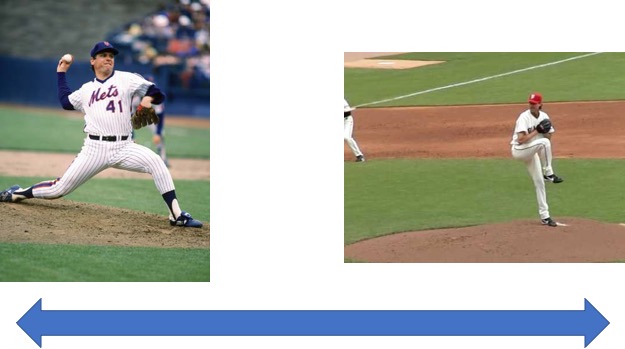
Classification: because we have used these terms for such a long time they’re a part of the baseball language which allows for better communication between all parties involved. We all know that Randy Johnson is the poster child for the “tall n’ fall” style while Tom Seaver represents the other far end of the spectrum with his famous “drop n’ drive” technique.
What to Discard
I want to discard the terms “tall”, “fall” and “drop” since they’re passive and don’t come close to describing the kind of actions we would like to see from the lower body when the goal is to throw a baseball really hard. If you tell anyone to be “tall and fall” you will basically paralyze that person from the waist down so in my opinion it has to be improved.
The same goes for term “drop” which doesn’t paint the kind of image we want our pitchers to think of when they need to load up their back leg and hip. This is why I want to replace them with action verbs like “dig”, “press” and “pop” which do a much better job of painting a picture of what we need them and their muscles to be doing.
Even though we are simply changing a couple of words we have to realize just how powerful the words that we select are and the affect they have on our athletes. And we can’t just keep using the ones that our coaches used because there’s a lot more information out there as to what works and what doesn’t work.
This information can be found in the scientific field coaching cues (if you’re looking it up on Google scholar or Pubmed type in “focus of attention”) and I’ve be very interested in this area since attending this presentation by Dr Nick Winkleman about 3 years ago.
This guy is the industry expert in coaching cues, in fact he completed his PhD in this field. Dr. Winkleman was one of the first coaches at Athletes’ Performance, which is now EXOS, and his specialty was preparing NFL hopeful’s for the combine. Despite his in depth knowledge of running mechanics and how to train these athlete’s in the weight room he wasn’t seeing the carry over that he wished for when it came to their sprinting ability. This lead him down the path of studying the science of coaching and has since popularized, through articles and presentations, the research in this area that has always been thought of as more of an art than a science.
The most prevalent research out there now is the difference between external cues and internal cues. An external cue places the attention of the athlete outside of their body whereas an internal cue places in their body. For example here are two cues for jumping that are saying the same thing in different ways:
- “push the ground away” – external cue
- “extend your knee and hip” – internal cue
In the research external cues have out performed internal cues for athletic abilities such balance, power, speed and aim.
So external cues are better which is pretty clear but “fall” and “drop” are external cues as well so we have to take things a step or two further. In order to make external cues even better let’s follow Dr Winkleman recommendations with what he calls the 3D’s.
Distance – Generally speaking cues that shift your focus further away have outperformed cues where the focus is closer, link to article, even if both sets of cues are external. For this particular cue with pitchers the furthest we can get is the mound when it comes to putting energy into the ground with either the DIG or the PRESS cue.
Direction – Here we need to think about whether we want to have our pitchers focus on moving TOWARDS home plate or moving AWAY from the rubber. In some studies by Porter they looked at the difference in standing long jump ability when they told the athletes to either (a) jump as far past the start line as you can or (b) jump as close to the cone as possible. When athletes were jumping towards a target, the cone, they performed better compared to when they were jumping away from a target.
This is one that we might want to be careful with since our goal with the back leg isn’t always to produce as much power as humanly possible since some pitchers can get carried away and cause problems with timing further up the chain.
It should be worth noting that if you have a strong athlete they might like focusing on driving away from the rubber as it allows them to generate more muscular force. While your springy/elastic pitchers might like focusing on moving towards their focus.
Description – This is probably the most important component of putting together quality coaching cues because it puts things into context for the athlete. Dr Winkleman talks about how we need to be careful about which action verbs we select because they define the spatiotemporal aspects of the movement. Spatiotemporal means space and time, both of which are obviously pretty important when it comes to pitching. As an example Dr. Winkleman compares the action verbs of push and punch. Both can be thought of as performing the same action but if we punch, the action is going to happen a lot quicker compared to pushing. In our pitching example the “drive” to me is slower than a “pop”. In the next article I will explain my use of the word “pop” which my not be the best verb for everyone but its way better than falling.
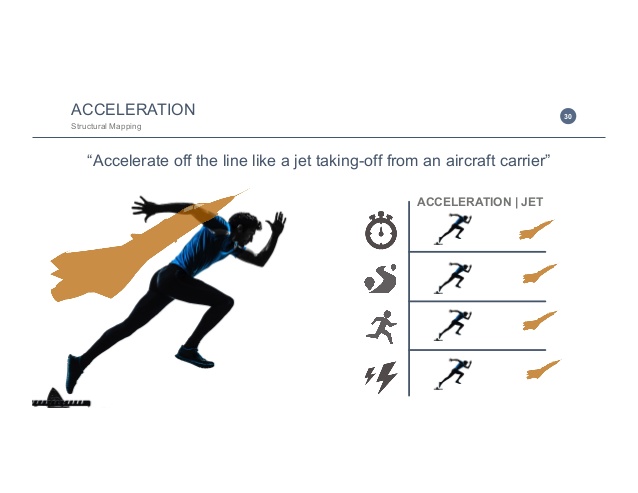
Another important component of a useful coaching cue is to use analogies. In sprinting for example, during the acceleration phase you might use the analogy of “taking off like a jet” to help communicate with the athlete that they can’t stand up too tall right away.
In our case with pitching I would try to paint the image of digging into the ground with a shovel. Hopefully they get the idea that they have to put their weight onto that back leg to put some force into the ground. This way you can elaborate a bit with the coaching cue by saying “Dig into the ground as if you were using a shovel”. If the athlete doesn’t get the idea grab them a shovel since every baseball field in the world has a shovel or two lying around. Just be sure to find them a firm piece of dirt to work with!!
On the other end of the spectrum the action verb of “Pressing” should also give the athlete a better idea of what’s happening with the muscles and tendons in the back leg. You can paint the picture in the athletes head about how the mound can be one big spring that you need to press into in order to get energy back.
In the next article I will elaborate on things a bit more as to why I choose these action verbs and which ones will work for which athletes.
Graeme Lehman, MSc, CSCS
 Lehman's Baseball
Leave a comment