This article is going to start exploring the idea of getting to know your athletes physically by building profiles that I introduced in part one, which you can check out here. To be a successful coach you also have also take into consideration the mental and emotional side of each athlete so that you can communicate and motivate effectively. This goes well beyond the scope of this article so, for now, we are going to stick with the physical side of things.
Building these physical profiles is the first step that we need to take in order to build customized mechanics that take advantage of each athlete’s strengths and weaknesses. It’s these strengths and weaknesses that make up a physical profile. Here is an example of a hypothetical profile that I put together for Marcus Stroman in part 1.
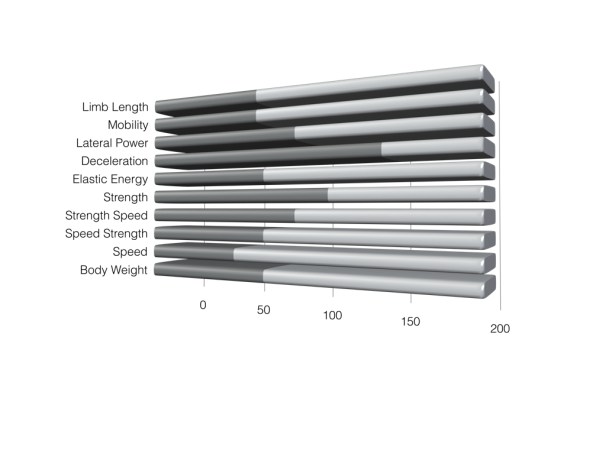
These profiles are composed of different attributes that make up the physical side of the athlete which we will go through one by one in this series.
The physical attributes that I’ve included cover a lot (but not all) of the athletic qualities that I feel are important to measure in order to get a better idea of what kind of athlete you’re dealing with both in the gym and more importantly on the mound.
Let’s get started by working our way down from the top.
Limb Length
This is where we want to get an idea of what kind of “frame” this athlete has and how we can use it to our advantage. In sports science world this is called anthropometrics.

In the vast majority of cases, the tracking and measurement of anthropometry starts and ends with standing height. If this is all that we are looking at then we are missing out on a ton of useful information. I want to know things like how much of that height is torso compared to the legs as well as how this height compares to their arm span.
When you put the word “anthropometry” and “throwing velocity” into Pub Med you don’t get a whole lot but there are a couple nuggets of information. This one, for example, looked at how the anthropometric measurements of elite-level female water polo athletes differed between positions (goalie, winger, center) as well as the common attributes of players that threw harder. Obviously, there are a lot of differences between water polo and baseball throwing, having your feet on the ground is the biggest on I can think of. They do however share commonalities like the intent of throwing as hard as possible which means that there is something we can learn from this water-based throwing sport. They found that along with being taller and having more muscle mass physical traits like wider shoulders, longer arm span and wider arms all contributed to throwing velocity.
This type of knowledge is great when we are talking about scouting/recruiting/talent identification but there isn’t a whole we can do to change these attributes when we are talking about the athlete you have in front of you today.
Since this trait is the least “trainable” it becomes the most important in my opinion to base everything around when developing an overall strategy both in the weight room and on the mound.
**Obviously this trait can change a lot when you are dealing with younger athletes. To learn more about this check out this article**
We can’t even start to talk about biomechanics if we don’t know what kind of limb lengths we are dealing with since it’s the foundation of the subject. The bones of the body are the levers of this human baseball-throwing machine that we are trying to engineer while the muscles, tendons, and nervous system are what move these levers to develop the kind of power we need to light up a radar gun.
Once you know what kind of frame and levers you have you can then start to build the best strategies to take advantage of strengths while minimizing weaknesses.
Here is a list of the other measurements that I would recommend which shouldn’t take more than 2 minutes.
- Standing Height
- Seated height
- Arm span
- Arm length
- Hand length
- Shoulder width
- Forearm length
- Torso length
- Shin length
Going through these measurements looks a lot like a tailor gathering the information they need to build you a customized suit rather than buying one off the rack.


How to use this information
You don’t have to be a rocket scientist to realize how long arms and wide shoulders can help generate more velocity yet we rarely measure these attributes. On second thought I guess we are kind of “rocket scientists “!!!
How exactly do we take advantage of these attributes or compensate for any shortcomings is a complicated question and would, in fact, take a “rocket scientist” to solve for each player. The answer from my perspective and I am still very much in the learning process, will include a combination of customized mechanical cues along with a training program that allows each athlete to maximize their strengths while minimizing their weaknesses. A lot of this will be discussed in future parts of this series when we explore the other physical attributes that make up a complete profile and how they relate back to the athletes’ anthropometrics.
For now, let’s look at an extreme example of how limb length plays into customized mechanics.
If you told everyone that they need a longer stride, throw more “over top” and lean really far forward at ball release to create forward trunk tilt you would only be correct part of the time. And in some cases, you might be completely wrong.
If you are dealing with taller pitchers with long limbs this type of advice might make things worse. When you have long limbs there is more POTENTIAL for throwing velocity but because of the complicated nature of throwing it makes controlling and sequencing these long limbs more difficult.
This can even be seen in the MLB since 93% of pitchers are taller than 6’0″ yet only 14% are taller than 6’4″, more isn’t always better.
**These numbers were from 1990 and 2000 so they have obviously changed a little but it is still a glaring stat**
Let’s look at Chris Sale for example. From reading Ben Brewster’s e-book “Building the 95 mph Body” I learned that Chris Sale has an 84-inch wingspan even though he is 6’6″. He is already on the tall end of the spectrum for pitchers then you add in that he has 6’8″ wingspan makes him even longer.
Judging by his mechanics he can rely more on a “rotational” and “upright” throwing style that allows him to take advantage of these long levers from a velocity and a deception point of view. This also allows him to break some “rules” like not having to stride out his entire body length or having a lot of forward trunk tilt at ball release which we know can both contribute to more throwing velocity, according to the research.
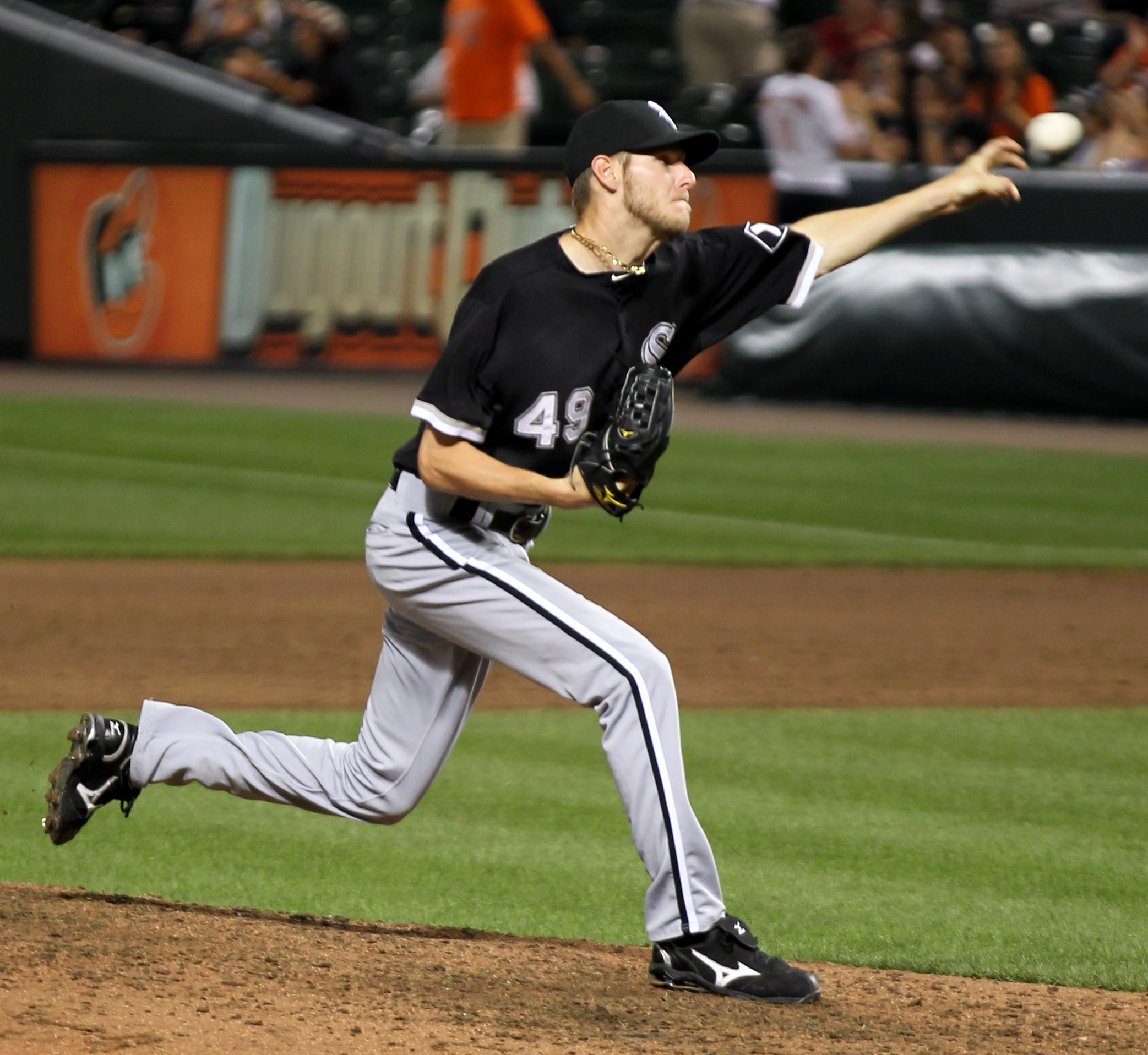
If we look at another famous pitcher with an even bigger 6’10’ wingspan, Randy Johnson, we can see a similar “upright” and “sidearm delivery” that takes advantage of long limbs. I don’t know if his wingspan was 6’10” but you get the point.

In part one we looked at the differences between the 6’4″ long-limbed Aaron Sanchez and the shorter (5’8″) yet powerful Marcus Stroman.

Both pitchers have different degrees of forward trunk tilt along with the angle of their legs going into the ground which would make their stride length based on a percentage of their height very different from one another.
If you get someone with these long levers and the freakish athletic ability to control these long limbs then you get this:

The strength and conditioning coach part of me also needs to take into consideration these physical differences. I don’t expect longer players to display the same type of strength that I would like to see from a shorter athlete.
It always comes back to the fact that POWER is the product of FORCE x VELOCITY. Athletes with longer limbs can rely more on the velocity side of the equation to produce their power due to their long levers. This means that I don’t need them to squat the same kind of loads that a shorter player needs to produce to compensate for their limited ability to create velocity and thus lean more heavily on the force end of the spectrum. Not to mention the fact that the biomechanics of a longer player don’t provide any advantages compared to their shorter limbed counterparts. Long limbs are great at lighter loads like a 5 oz baseball really fast. Squatting calls for moving a heavy load really slow, about 1 mph.
Conclusion
This is a subject that needs to be explored more in-depth. In the future, I will keep my eyes posted for new research and write about its implications as I learn more. The next parts of this series that explore the other physical attributes that make up this profile will all be related back to the athlete’s anthropometrics since it is the attribute that is the least adaptable thus must be accounted for before anything else.
Graeme Lehman, MSc, CSCS


Leave a comment